

The "Zero Experience" Myth: How to Sell Your PhD to Industry
Category: Career Advice / PhD Transition
Reading Time: 4 minutes
__
The "Overqualified but Under-experienced" Paradox
It is the single most frustrating Catch-22 for PhDs looking to transition into biotech or biopharma.
You have spent 4, 5, or even 6 years managing complex projects, overseeing budgets, mentoring students, and publishing novel data.
Yet, when you look at entry-level industry job descriptions, you are hit with a wall:
Requirements: PhD plus 2-3 years of industry experience.
It begs the question: How are you supposed to get experience if no one will hire you without it?
The answer lies in a simple mindset shift. You don’t need to get more experience; you need to change how you sell the experience you already have. Your PhD is not just education—it is professional work. Here is how to make companies see it that way.
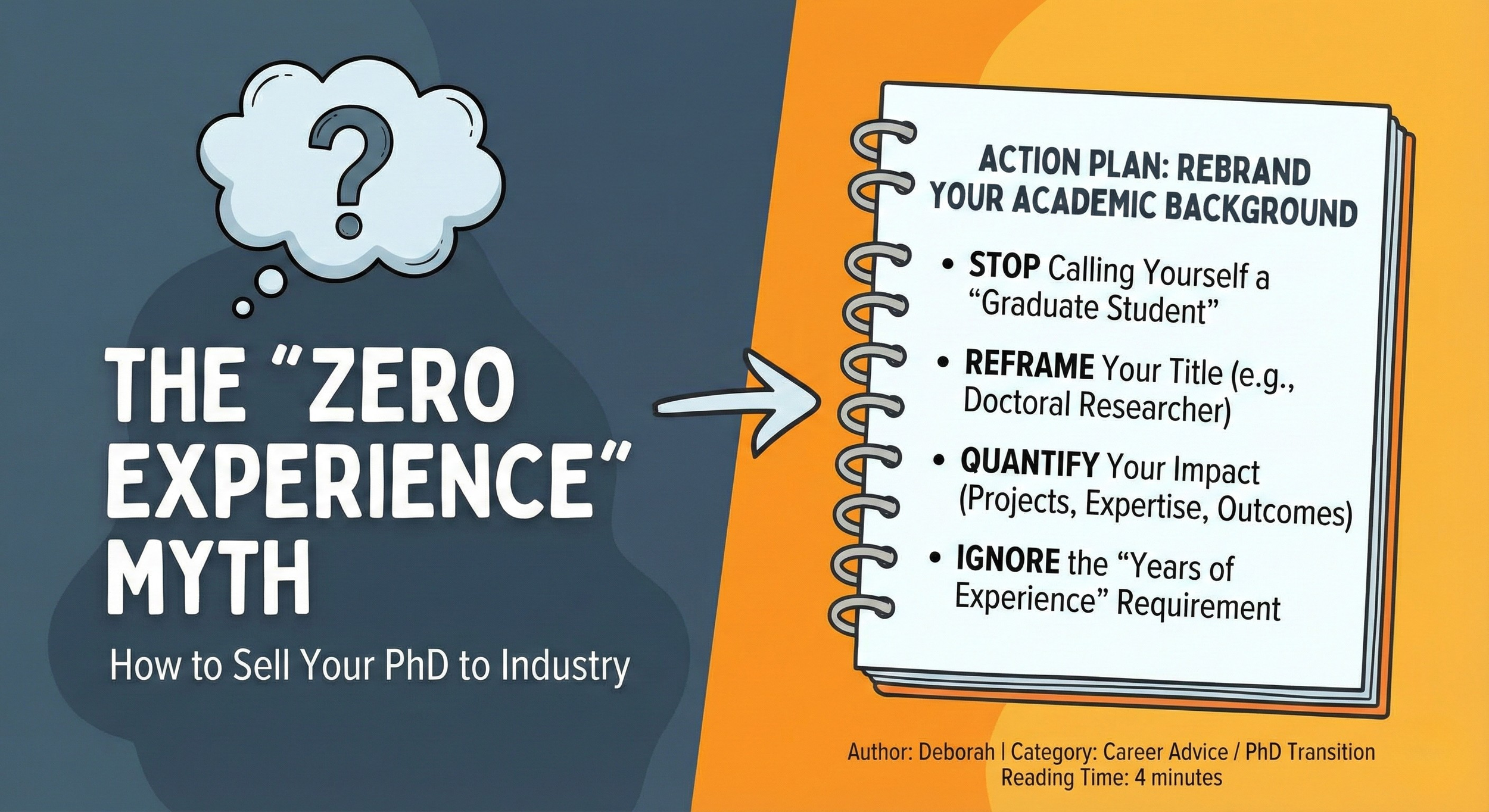
Step 1: Stop Calling Yourself a "Graduate Student"
Go open your LinkedIn profile or your resume. Look at your most recent entry. Does it say "Graduate Student at [University Name]"?
If it does, you are inadvertently sabotaging your application.
In the corporate world, the word "student" signals someone who is learning, not doing. It signals "junior," "untrained," and "high risk." When a recruiter sees that title, they categorize you as an entry-level academic rather than a capable scientist.
The Fix: Reframe Your Title
You need to use titles that reflect the work you actually performed. Swap "Graduate Student" for:
· Doctoral Researcher
· Immunologist
· Research Fellow
· Graduate Research Assistant
The Strategy: Quantify Your Impact
Once you have changed the title, you must change the description. Do not simply list your thesis title. Instead, treat your PhD years exactly like a job entry on a resume:
o List Your Projects: Instead of "Studied X," say "Led a 4-year longitudinal study on cardiovascular dysfunction."
o Highlight Technical Expertise: "Developed and optimized novel assays for protein analysis."
o Showcase Outcomes: "Authored 3 peer-reviewed publications and presented findings at international conferences."
When you strip away the academic jargon and present your PhD as a series of managed projects with deliverables, you force recruiters to see you as a professional with a track record.
Step 2: Ignore the "Years of Experience" Requirement
This is the part where most PhDs self-reject. You find a dream role, scroll to the bottom, and see a requirement for "3-5 years of postdoctoral experience." You sigh, close the tab, and move on.
Don't do that.
Job descriptions are rarely hard lists of non-negotiable requirements; they are a hiring manager’s "wish list." They are describing their perfect, unicorn candidate.
My Personal Experience: The "5-Year" Rule
I want to share a personal reality check. When I was transitioning out of academia, I found a job description that matched my skills perfectly—except for one line. It explicitly required five years of postdoctoral experience.
At the time, I didn't have a postdoc. I had zero years of "official" post-PhD industry experience.
I applied anyway.
Why? Because I knew my skills matched the needs of the role, even if my timeline didn't match the requirements. I leaned heavily into the transferable skills I gained during my PhD—data synthesis, project management, and scientific communication.
The result? I got the job.
They hired me over candidates who had the "required" years because I demonstrated value and competence.
The Bottom Line
If you are sitting there thinking your PhD is just a degree, stop.
It is years of crisis management, budget oversight, and cross-functional collaboration.
Companies recognize competence even when they don't recognize the timeline.
Your Action Plan for Today:
o Audit your LinkedIn: Change "Student" to "Researcher."
o Quantify your research: Don't say "did research," say "Managed 4 concurrent projects."
o Apply boldly: If you match 70% of the skills, apply for the job—even if you don't have the years.
Leaving academia isn’t failure—it’s strategy.