
Your PhD Is a Business Asset, Not Just a Degree
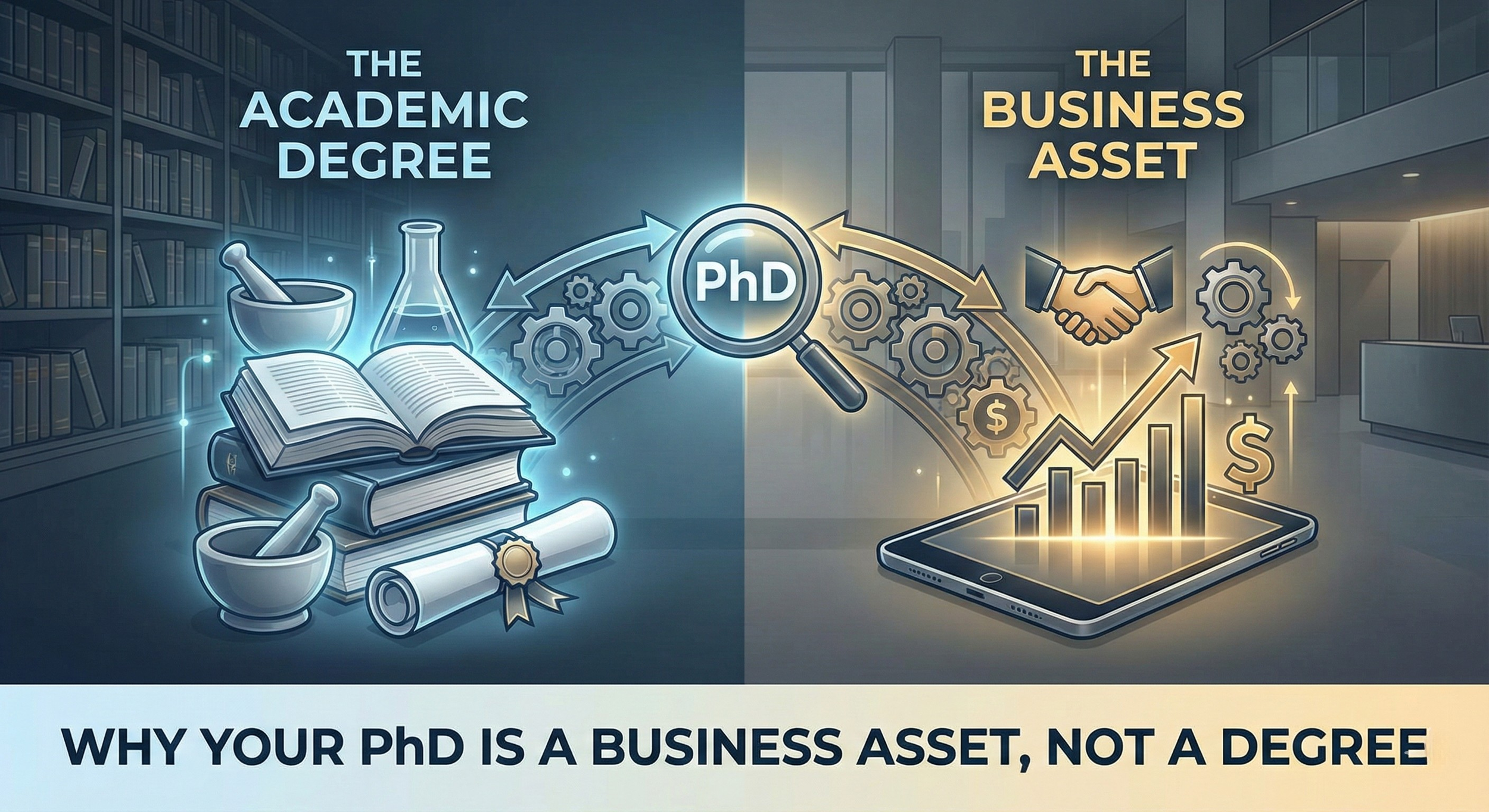
This graphic illustrates the concept of "transferable skills," marketing the idea that a doctorate is not just an educational milestone but a valuable commercial tool that drives business growth and revenue.
Category: Career Advice / PhD Transition | Reading Time: 3 minutes
—
Most scientists undersell their value because they focus on the credential, not the capability.
When PhDs look to leave academia, they often face a significant mental block.
It is a harsh truth, but one that is necessary to accept if you want to transition successfully:
Industry does not care about your experiments.
They don’t care that you ran 400 Western Blots. They don’t care that you spent six months troubleshooting a single antibody. And they definitely don’t care about the specific title of your thesis.
What they care about is this: Can you solve a business problem?
It is time to reframe your PhD. It is not just a degree; it is a massive business asset. But to get hired, you have to learn how to sell it that way.
The Product Mindset: Inputs vs. ROI
When we write academic CVs, we are trained to list inputs. We list the techniques we know, the papers we read, and the hours we spent at the bench. This is the "Student Mindset"—you are trying to prove you did the work.
In industry, you need a Business Mindset.
You aren't selling your effort; you are selling your ROI (Return on Investment).
Think of yourself as a product.
A company has a "pain point"—maybe their clinical trial is stalled, or their data pipeline is messy. They are hiring you to be the painkiller.
If you interview talking about "learning opportunities," you sound like a student.
If you interview talking about "optimizing workflows" and "accelerating timelines," you sound like an asset.
Translation in Action: From "Lab Rat" to Business Leader
How do we translate specific lab skills into language that hiring managers value? It requires shifting from describing what you did to describing the strategic value of that action.
Here are three common examples of how to rewrite your narrative:
1. The Literature Review
Academic Phrasing: "I read 100 papers to write my introduction."
Business Asset Phrasing: "I conducted a comprehensive landscape analysis to identify gaps in the market and determine the feasibility of a new research direction."
The Shift: One is reading; the other is strategic planning.
2. Troubleshooting Experiments
Academic Phrasing: "I fixed the PCR protocol after it failed three times."
Business Asset Phrasing: "I performed root-cause analysis on a stalled project, identified the bottleneck, and implemented a new SOP that increased data output by 50%."
The Shift: One is fixing a mistake; the other is operational excellence.
3. Mentoring Undergrads
Academic Phrasing: "I helped a summer student."
Business Asset Phrasing: "I managed junior personnel, delegating tasks and providing oversight to ensure project milestones were met on time."
The Shift: One is being helpful; the other is people management and leadership.
The "So What?" Factor
The next time you look at your resume, apply the "So What?" test.
You used Python? So what?
Did you use it to automate a manual process that saved the lab 10 hours a week? That is business value.
You presented at a conference? So what?
Did you communicate complex technical data to key stakeholders to secure grant funding? That is business value.
Your PhD trained you to learn fast, handle failure, analyze data without bias, and manage complex projects with zero budget. Companies pay consultants thousands of dollars a day for those exact skills. You already possess them; you just need to stop burying them under technical jargon.
Your Challenge for This Week
Stop apologizing for being an academic. Your PhD is not a liability. It is your competitive advantage—but only if you treat it like one.
Try this: Find one bullet point on your resume that focuses on a "task" (e.g., "performed cell culture") and rewrite it to focus on the result or business impact.
Did you find this helpful? Listen to the full breakdown on The PhD Pulse Podcast, Episode 3.